
AI Chatbot
Led UX research and strategy for improving enterprise chatbot experiences across multiple business units at CIBC. The goal was to evaluate current chatbot performance, identify gaps, and define a scalable, user-centred approach for future chatbot implementations.
Project Requirements
Define a scalable, user-centred chatbot strategy for CIBC by evaluating existing solutions, identifying experience gaps, and designing a future-state framework that improves usability, reduces customer friction, and increases self-service efficiency.
As part of the research process, I facilitated cross-functional SBU workshops to uncover key chatbot use cases, existing solutions, and pain points across the organization. I conducted interviews with LOB partners and chatbot product owners to understand current limitations and identify opportunities for improvement, alongside user interviews to capture real-world challenges and usage behaviors. I synthesized complex architecture and integration diagrams to map how chatbot systems interacted with existing platforms. Additionally, I conducted market and competitor research to benchmark UX best practices and evaluate leading solutions. These insights were then translated into actionable design recommendations aimed at improving usability, flexibility, and overall chatbot effectiveness.

Problem Statement
My Role
Led UX research and synthesis across multiple chatbot initiatives
Conducted stakeholder and user interviews to uncover pain points
Translated insights into UX frameworks and design recommendations
Collaborated with product, engineering, and business teams
Contributed to defining the future-state chatbot experience
Worked cross-functionally with:
Product owners across multiple lines of business
Engineering teams to understand system constraints
Business stakeholders to align on KPIs and priorities
Facilitated alignment across siloed teams to create a unified chatbot strategy.
CIBC had multiple chatbot implementations across different lines of business, but they were fragmented, inconsistent, and underperforming.
Users struggled with:
Low response accuracy
Rigid conversation flows
Lack of seamless escalation to human agents
Poor discoverability and engagement
This resulted in low trust, increased frustration, and higher dependency on customer support channels.

Research Approach
To understand the current landscape, I conducted a combination of qualitative and strategic research:
Facilitated SBU workshops to uncover use cases and pain points
Interviewed chatbot product owners across lines of business
Conducted user interviews with internal chatbot users
Analyzed current chatbot architectures and vendor capabilities
Performed competitive benchmarking and UX best practice analysis
Primary Research / Common Frustrations
The chatbot has no personality – it answers dully and inflexibly like a machine. That’s neither the best customer experience nor the best impression for your brand.
Chatbot doesn’t understand the questions or has very limited access to answers (data). This makes for a terrible bot experience for users. Make sure to set up your bot in a way that it can answer questions.
The dialogue only follows rigid patterns, but cannot do anything with differently asked questions or comments, and is then stuck in an endless loop. Find happy flows that will smoothly allow your bot to ask for more information in different ways.


Key Insights
Our research revealed that the most effective chatbot experiences are those that prioritize simplicity, clarity, and intuitive navigation. Users expect interactions to feel dynamic and engaging, rather than static or overly scripted. A critical factor in success is the chatbot’s ability to understand natural language variations and accurately interpret user intent, rather than relying on rigid keyword-based responses. Additionally, context-aware interactions significantly improve relevance and user satisfaction, while guided elements such as prompts and clickable options help reduce friction and support smoother decision-making. Overall, chatbot experiences that balance flexibility with structure tend to deliver the highest engagement and usability.
Chatbots fail to understand user intent, leading to repeated errors
User Frustrations

Systems often reset before resolution, they feel robotic and lack personality

Lack of human handoff creates frustration during complex queries

Users get stuck in looped conversations with no resolution
Trade-offs & Constraints
Balancing advanced AI capabilities with existing tech stack limitations
Aligning multiple stakeholders with competing priorities
Designing scalable solutions across fragmented systems
UX Strategy & Recommendations
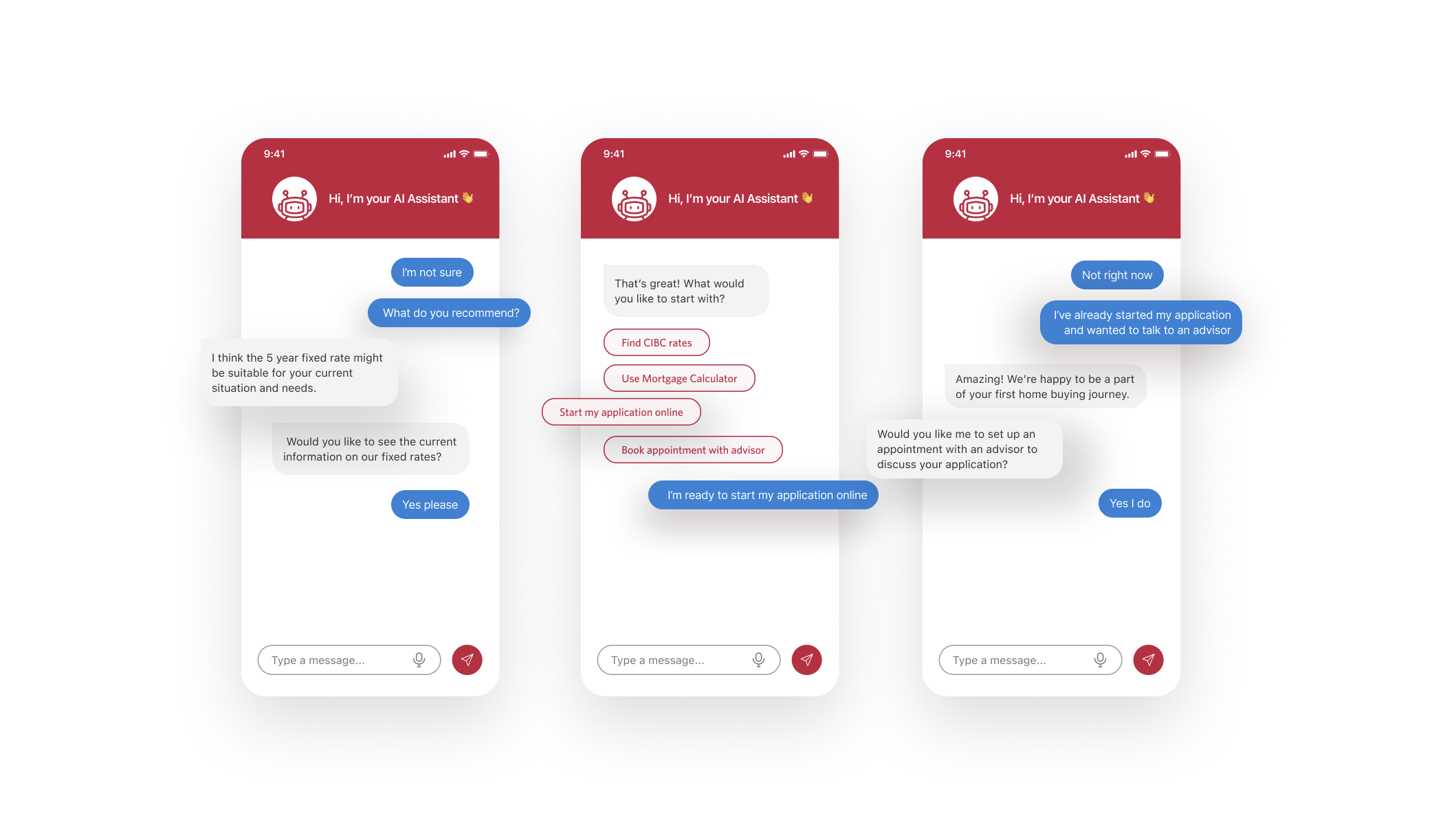
Designed scalable conversational flow frameworks
Proposed integration of AI capabilities such as semantic search and sentiment analysis
Defined chatbot interaction patterns for improved usability
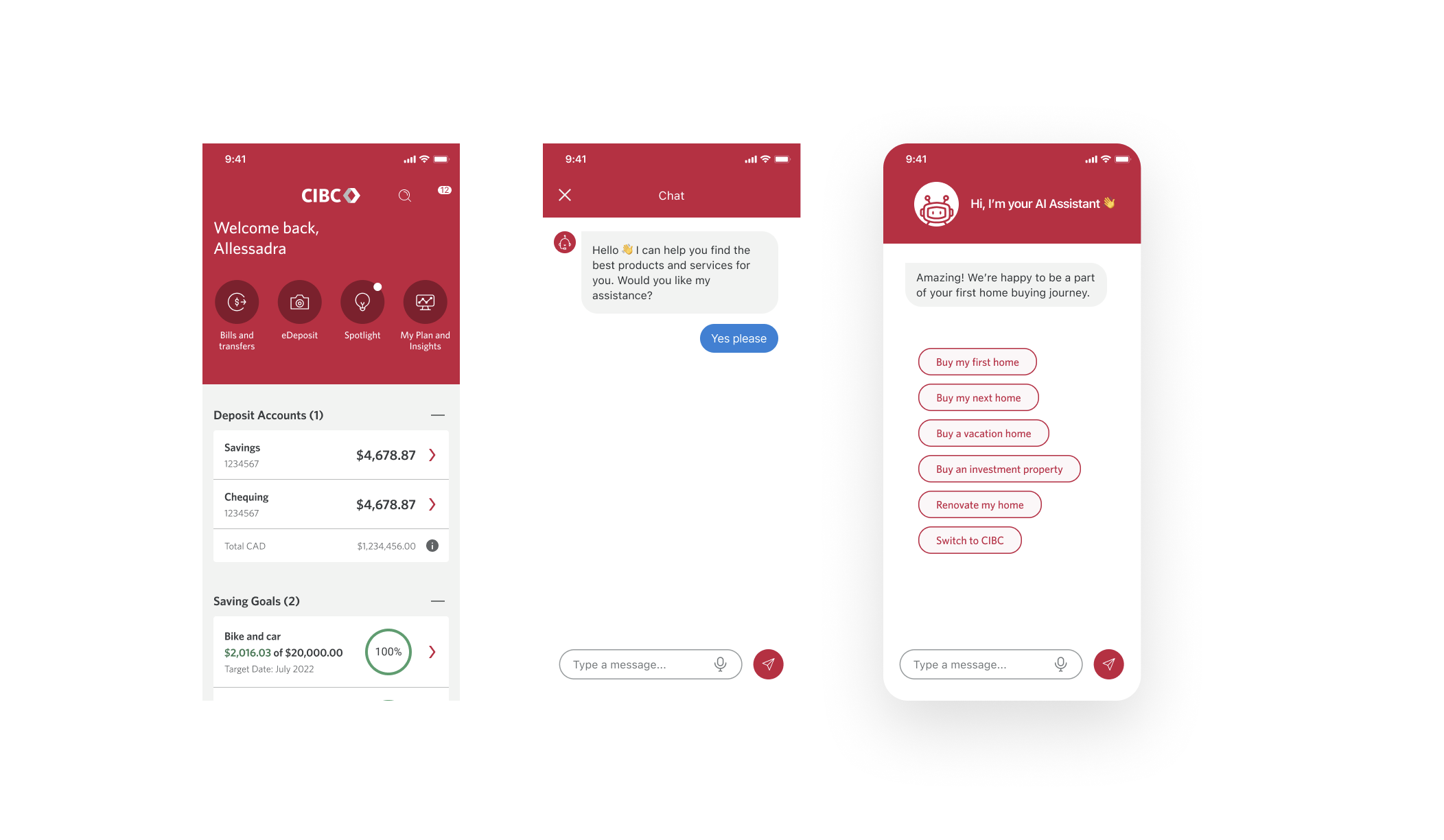
Recommended contextual entry points within high-friction user journeys
Developed a future-state vision for enterprise chatbot experiences
Impact
Identified key gaps across existing implementations
Influenced future roadmap and investment decisions
Improved alignment across business and technology teams
Design Principles
Design for flexibility, not rigid flows
Enable seamless human handoff for complex queries
Prioritize clarity and guided interactions
Introduce conversational tone and personality
Leverage context and user intent to personalize responses
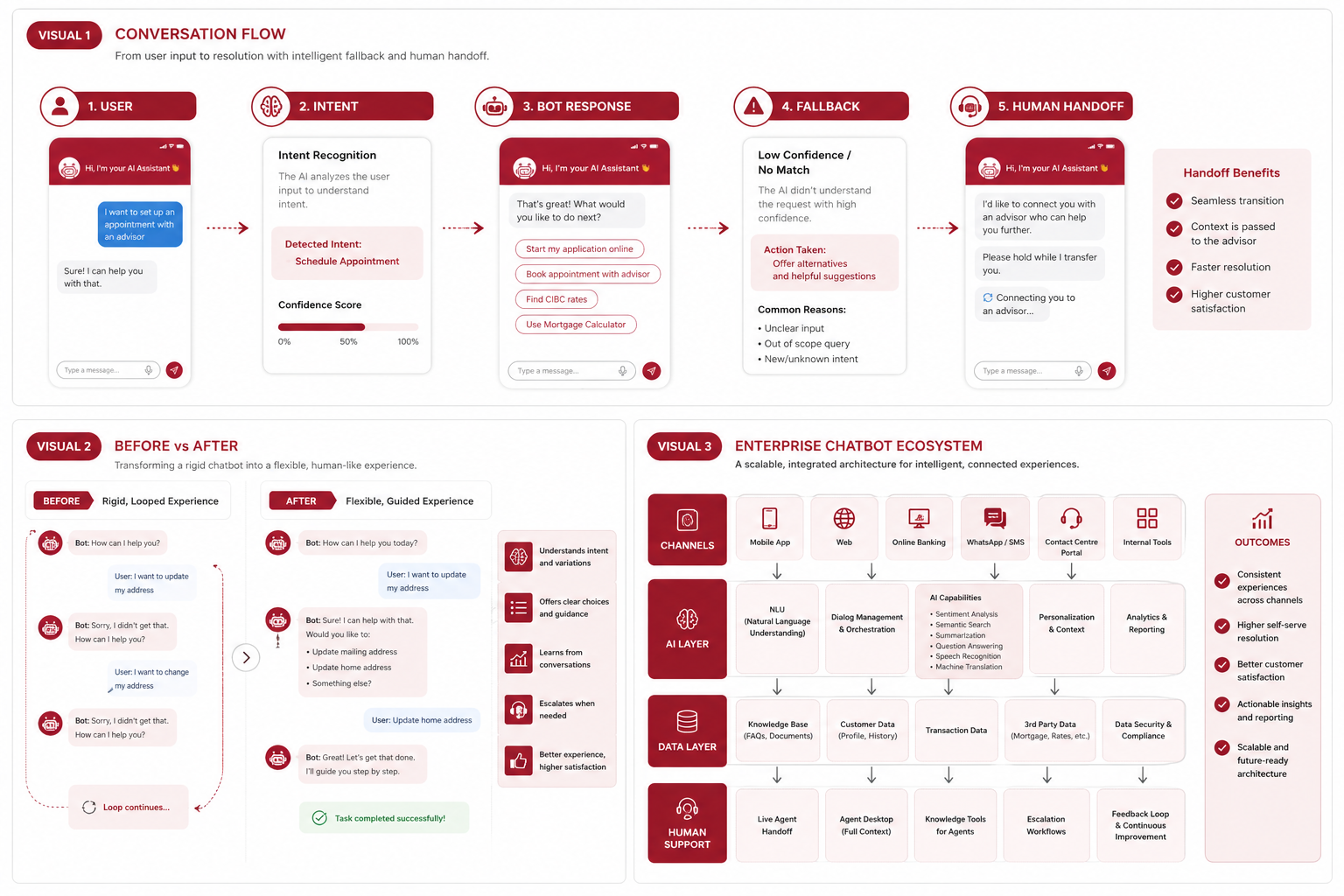
I created a series of supporting visuals to clearly communicate the chatbot experience and underlying ecosystem. This included a conversation flow diagram mapping the user journey from intent recognition to bot response, fallback handling, and seamless human handoff.
I also designed a before-and-after comparison to highlight the shift from rigid, loop-based interactions to a more flexible, guided experience.
Additionally, our team developed an enterprise chatbot ecosystem framework illustrating how different layers of channels, AI capabilities, data infrastructure, and human support work together to deliver a cohesive and scalable solution. These visuals helped translate complex concepts into clear, digestible insights for stakeholders.
AI - Capabilities that are Required
Sentiment analysis
Determining the sentiment behind a phrase
Summarization
Expressing the most important facts of a text
Semantic search
Applying user intent the meaning to find the right content
Question answering
Answer questions posed in a natural language
Speech recognition
AI machine is able to process speech audio
Machine translation
The translation of one language to another by a machine
Opportunities for AI capabilities
Reflection
This project highlighted the importance of designing chatbots as part of a broader ecosystem rather than standalone tools. If I were to take this further, I would focus on validating solutions through usability testing and measuring real user impact post-implementation.